cusco · Sacred Valley Tour from Cusco
Sacred Valley Tour from Cusco
Between Cusco and Machu Picchu lies one of the most historically rich and visually stunning corridors in the Americas. The Sacred Valley of the Incas — Vilcanota...
Quick Answer — Sacred Valley at a GlanceWhat: A full-day guided excursion through the Urubamba River valley — the agricultural and spiritual heartland of the Inca Empire. Top sites: Pisac ruins & market, Ollantaytambo fortress, Maras salt mines, Moray circular terraces, Chinchero. Duration: 8–10 hours from Cusco (most tours depart 8–9am, return by 6–7pm). Altitude: The valley sits at 2,800m — lower than Cusco (3,400m). Great first stop for acclimatization. Price: Tours from $16 (half-day) to $449 (2-day Machu Picchu combo); full-day group tours from $29, private full-day from $115. Lunch included on most full-day tours. Best for: Everyone — history lovers, photographers, foodies, and first-time visitors acclimatizing from the coast. |
Between Cusco and Machu Picchu lies one of the most historically rich and visually stunning corridors in the Americas. The Sacred Valley of the Incas — Vilcanota in Quechua — stretches 60 kilometers along the Urubamba River through a landscape of terraced Andean hillsides, snow-capped peaks, colonial villages, and some of the most impressive Inca architecture outside of Machu Picchu itself.
For the Inca emperors, this valley was not just beautiful — it was sacred. Its fertile floor, protected from frost by lower altitude and warmed by the river, produced the finest maize in the empire. Its hillsides were sculpted into agricultural terraces that are still being studied by modern agronomists. Its fortresses guarded the road to Machu Picchu, and its temples housed the most revered ceremonies in the Inca calendar.
Today, a Sacred Valley day tour from Cusco is one of the most satisfying ways to spend a day in the region — and one of the smartest, since the lower altitude (around 2,800m) makes it an ideal first excursion for newly arrived travelers still adjusting from sea level.
Sacred Valley — Essential Facts
|
Location |
60 km northwest of Cusco along the Urubamba River |
|
Altitude |
2,700–2,900m — significantly lower than Cusco (3,400m) |
|
Best time |
Year-round — dry season (May–Oct) for clearest skies; wet season for lush green terraces |
|
Tour length |
Full day: 8–10 hours. Half day options available for Pisac or Ollantaytambo only. |
|
What to bring |
Layers, sunscreen, comfortable walking shoes, camera, cash for market shopping |
|
Boleto Turístico |
Required for most archaeological sites — your tour operator handles this (~$15–$45 depending on type) |
|
Best combo |
Sacred Valley + Inca Trail (Ollantaytambo is the Inca Trail train departure point) |
|
Distance |
Approx. 1.5–2 hrs from Cusco by road to Pisac; 2–2.5 hrs to Ollantaytambo |
Top Sites in the Sacred Valley — Complete Guide
Here is every major site you will visit on a Sacred Valley tour, what makes it special, and how long to allow:
|
Site |
Type |
Altitude |
Time Needed |
Highlight |
Included in Tour? |
|
Pisac Ruins |
Inca Ruins |
3,350m |
1.5–2 hrs |
Sweeping terraces, agricultural zones, and ceremonial complex with panoramic valley views |
Most full-day tours |
|
Pisac Market |
Market / Culture |
2,970m |
1–1.5 hrs |
One of Peru's largest artisan markets — textiles, ceramics, jewelry. Best on Sunday. |
Most full-day tours |
|
Ollantaytambo Ruins |
Inca Fortress |
2,792m |
1.5–2 hrs |
The best-preserved Inca town in Peru — massive Temple of the Sun, living Inca terraces still inhabited |
Most full-day tours |
|
Maras Salt Mines |
Natural / History |
3,380m |
45–60 min |
3,000+ salt evaporation pools in use since Inca times — visually extraordinary |
Some full-day tours |
|
Moray Terraces |
Inca Site |
3,500m |
45–60 min |
Concentric circular terraces — believed to be an Inca agricultural climate lab |
Some full-day tours |
|
Chinchero |
Village / Market |
3,762m |
1–1.5 hrs |
Colonial church atop Inca walls, Sunday market, traditional textile demonstrations |
Some tours |
|
Urubamba Town |
Lunch stop |
2,863m |
45–60 min |
Most tours include a buffet lunch here — excellent opportunity to try Andean cuisine |
Most full-day tours |
|
Ollantaytambo village |
Living Inca Town |
2,792m |
30–45 min |
The streets themselves are original Inca — narrow stone channels carry water as they did 500 years ago |
All tours visiting Ollantaytambo |
The Top Sacred Valley Sites — In Depth
Pisac — Ruins Above, Market Below
Pisac is the Sacred Valley's double act: dramatic hilltop Inca ruins looking down on one of Peru's most vibrant traditional markets in the valley below. Most tours visit both.
The Pisac archaeological complex sits at 3,350m on a ridge above the town, and it is considerably larger and more impressive than most visitors expect. Carved into the mountainside over a kilometer of terraced hillside, it includes an agricultural zone, a residential sector, a ceremonial precinct with a magnificent Intihuatana (sun-tracking stone), a military zone, and an extraordinary network of water channels still flowing after 500 years. The views down the valley and across to the snow-capped peaks beyond are among the finest in the region.
Below in the town, the Pisac market is at its most spectacular on Sundays, when local Quechua communities from surrounding mountain villages descend to sell hand-woven textiles, ceramics, silver jewelry, and local produce. Even on weekdays, the market is large and worth exploring — but Sunday is exceptional.
Ollantaytambo — The Living Inca Fortress
Ollantaytambo is, by most measures, the highlight of any Sacred Valley tour — and one of the most remarkable archaeological sites in all of Peru. Unlike Machu Picchu (which was abandoned after the Spanish conquest), Ollantaytambo was both a military fortress and an active Inca town that continued to be inhabited after the conquest. The town's street grid is original Inca, water channels run through the lanes exactly as they did in the 15th century, and families still live in buildings that stand on Inca foundations.
The fortress itself rises in enormous terraced platforms above the town — each terrace supported by perfectly fitted pink granite blocks quarried from a mountain across the valley and transported without wheels or iron tools. At the top, the unfinished Temple of the Sun (construction was abandoned when the Spanish arrived) features six monolithic stone blocks fitted with such precision that not even a sheet of paper can be inserted between them.
Ollantaytambo also serves as the train departure point for Machu Picchu — if your tour continues to Machu Picchu, you board the train here.
Maras Salt Mines — 3,000 Pools of Pink Gold
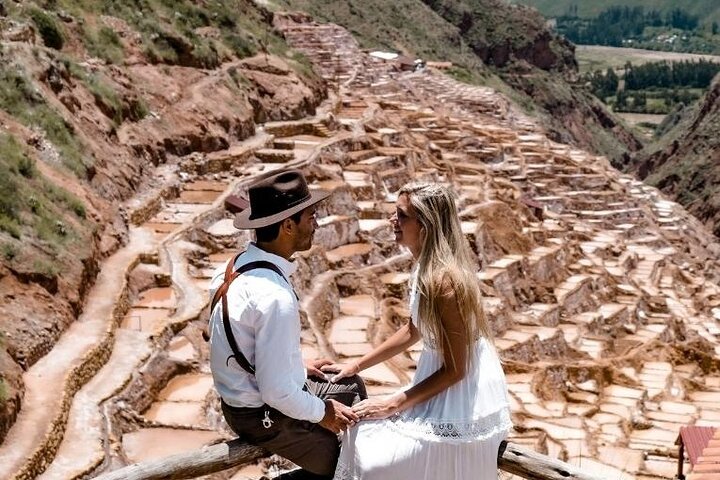
Approximately 40 minutes from Ollantaytambo, the Maras salt mines are one of those landscapes that photographs cannot fully prepare you for. A brine spring high on the hillside feeds over 3,000 individual salt evaporation pools — each one a slightly different shade of white, pink, and terracotta depending on its mineral content and age. The system has been in operation since before the Inca empire, and the same local families that worked these pools under the Inca now own and operate them cooperatively.
You can walk among the pools along narrow paths, watch the harvesting process (best in the dry season when evaporation is fastest), and buy small bags of the mineral-rich salt directly from the families who produce it.
Moray — The Inca Agricultural Laboratory
Moray is one of the most intellectually fascinating sites in the Sacred Valley. Three concentric circular depressions carved into the earth create a series of stepped terraces descending to a central point — the largest bowl is 30 meters deep. Temperature measurements have shown that each terrace level maintains a different microclimate, with the difference between the top and bottom reaching as much as 15°C. Researchers believe this was a sophisticated Inca agricultural research station for experimenting with growing different crops at different altitudes simultaneously — essentially a climate simulation laboratory built from stone.
Moray is often combined with Maras in a half-day addition to a full Sacred Valley tour, and is worth the extra hour.
Sacred Valley Tours from Cusco — Compared (2026)
Here are the best-reviewed Sacred Valley tours available through Viator, with clear comparison of what each includes:
|
Tour Name |
Duration |
Group |
Sites Covered |
Price (USD) |
Best For |
Sacred Valley Tour: Pisac & Ollantaytambo Classic |
Full day |
Max 10 |
Pisac ruins & market, Taray viewpoint, animal rescue center (llamas/alpacas), train-timed arrival at Ollantaytambo |
From $29 |
Budget-conscious, first-time visitors wanting the classic route |
The Ultimate Full Day Sacred Valley Tour |
Full day |
Max 8 |
Chinchero, Maras salt mines, Moray terraces, Ollantaytambo — all 4 major sites at an unhurried pace |
From $139 |
Travelers wanting the complete experience without feeling rushed |
Sacred Valley Private Tour, Moray & Salt Mines |
10 hrs |
Private |
Chinchero, Maras salt mines, Moray, Ollantaytambo, Pisac — private guide & vehicle, flexible pace |
From $115 |
Families, couples, or anyone wanting a personalized pace |
2-Day Sacred Valley & Machu Picchu Tour by Train |
2 days |
Small group |
Day 1: alpaca/vicuña sanctuary, Pisac, Ollantaytambo. Day 2: scenic train to Machu Picchu. |
From $449 |
Travelers combining both in an efficient 2-day journey |
Moray, Maras Salt Mines & Chinchero Weavers Half-Day |
6–7 hrs |
Small group |
Chinchero textile center, Moray terraces, Maras village & salt mines |
From $16 |
Travelers with limited time or arriving/departing Cusco |
|
Pro Tip: The Sacred Valley Before the Inca Trail If you are starting the Inca Trail, the train departs from Ollantaytambo (not Cusco). Many trekkers do a Sacred Valley tour on the day before their trek begins — you end the tour at Ollantaytambo, spend the night there, and start the trail at Km 82 the next morning. This is logistically smarter and gives you an extra acclimatization day at lower altitude before the physical demands of the trek. |
Sample Full-Day Sacred Valley Itinerary — Hour by Hour
This is a typical schedule for the most popular Sacred Valley full-day tour from Cusco:
|
8:00am |
Pickup from your Cusco hotel. The drive to the Sacred Valley takes approximately 1.5 hours on scenic mountain roads — have your camera ready for the descent into the valley. |
|
9:30am |
Arrive at the Pisac archaeological complex. Guided tour of the terraces, ceremonial zones, and Intihuatana stone (~1.5 hours). Views across the Sacred Valley from the ridge. |
|
11:15am |
Descend to Pisac town for the artisan market. Free time to browse handwoven textiles, alpaca goods, ceramics, and silver jewelry from local Quechua vendors (~1 hour). |
|
12:30pm |
Drive to Urubamba for a traditional Peruvian buffet lunch — typically included in the tour price. Expect quinoa soup, ceviche, roast meats, and fresh Andean vegetables. |
|
2:00pm |
Optional add-on: Maras salt mines and Moray terraces (~1.5 hours combined). Not all tours include this — check when booking if you want both. |
|
3:30pm |
Arrive at Ollantaytambo. Guided tour of the fortress and living Inca town (~1.5–2 hours). Climb the massive ceremonial terraces for panoramic views over the town and valley. |
|
5:30pm |
Depart Ollantaytambo for Cusco. The return drive takes approximately 1.5–2 hours via the main Cusco–Urubamba highway. |
|
7:00pm |
Drop-off at your Cusco hotel. Optional evening in the Plaza de Armas — a 10-minute walk from most hotels. |
Sacred Valley Tips — What to Know Before You Go
Altitude & Acclimatization
One of the best-kept secrets about the Sacred Valley is that it sits at 2,700–2,900m — significantly lower than Cusco at 3,400m. For travelers still adjusting from sea level, the Sacred Valley is an excellent first day trip: you get extraordinary sights while giving your body time to adjust at lower pressure.
Many guides recommend visiting the Sacred Valley before Machu Picchu for this reason — you ease into altitude gradually rather than jumping from Cusco to Machu Picchu in one day.
Market Shopping Tips
|
Tips for Shopping at Pisac Market Cash only — most vendors do not accept cards. Bring Peruvian soles (PEN). Bargaining is accepted but be respectful — these are artisan families, not commercial retailers. A 10–15% reduction is reasonable; aggressive haggling is frowned upon. Best buys: Hand-woven alpaca textiles (look for 100% alpaca, not acrylic blends), locally made ceramics with geometric Inca patterns, silver jewelry with semiprecious stones. Sunday market is the largest and most atmospheric — if your tour date is flexible, try to go on a Sunday. Carry a daypack or tote bag — you will want room for your purchases. |
What to Wear
- Light layers — the valley is warmer than Cusco (5–8°C warmer) but mornings and evenings are still cool
- Comfortable walking shoes — the Pisac and Ollantaytambo ruins involve uneven stone steps
- Sunscreen and a hat — UV intensity is high even on overcast days at altitude
- A light rain jacket — afternoon showers are possible, especially October–April
- A small daypack for water, snacks, and market purchases
The Boleto Turístico — What You Need to Know
Entry to most Sacred Valley archaeological sites (Pisac ruins, Moray, Chinchero, Ollantaytambo) requires the Boleto Turístico de Cusco — a combined tourist ticket available in partial or full versions. Costs approximately $15–$45 USD depending on the version. Your tour operator includes this in the tour price or purchases it for you on arrival — confirm when booking. Machu Picchu requires a separate ticket.
Frequently Asked Questions — Sacred Valley Day Trip
|
Question |
Answer |
|
Is the Sacred Valley worth visiting if I'm going to Machu Picchu? |
Absolutely — they are completely different experiences. Machu Picchu is one single, extraordinary site. The Sacred Valley gives you four or five major archaeological sites, a living market town, and the broader cultural and agricultural context of the Inca Empire. They complement each other perfectly and most travelers strongly recommend doing both. |
|
What is the best Sacred Valley tour from Cusco? |
For most first-time visitors on a budget, the Pisac & Ollantaytambo Classic Tour (from $29) covers the essential sites. For the most complete single-day experience — Chinchero, Maras, Moray, and Ollantaytambo without rushing — The Ultimate Full Day Sacred Valley Tour (from $139) is the best-reviewed option, rated 4.92★ across 673 reviews. Private tours (from $115) are ideal for families and those who want a flexible pace. |
|
Can I visit the Sacred Valley independently without a tour? |
Yes — colectivo minivans run from Cusco's Pavitos terminal to Pisac (~1.5 hrs, ~$2) and from Pisac to Ollantaytambo (~1 hr, ~$2). However, you will need to arrange your own transport between sites, which can be slow and unpredictable. A guided tour is significantly more efficient and typically includes lunch and entry fees — making the price difference smaller than it appears. |
|
Which day is best for the Pisac market? |
Sunday is the most spectacular — the full artisan market with local Quechua communities from surrounding villages. Tuesday and Thursday also have markets, smaller but less crowded. Other days have a reduced market presence. |
|
How does the Sacred Valley tour connect to Machu Picchu? |
Ollantaytambo is the main train departure point for Machu Picchu — the Peru Rail and Inca Rail trains to Aguas Calientes depart from here. Many travelers do the Sacred Valley on Day 1, spend the night in Ollantaytambo, and board the morning train to Machu Picchu on Day 2. This is highly recommended and saves the 1.5-hour drive back to Cusco. |
|
Is the Sacred Valley suitable for children? |
Yes — it is one of the most family-friendly destinations in the Cusco region. The lower altitude reduces altitude sickness risk for children. The market is engaging for kids of all ages. Ollantaytambo has open terraces that children love to climb. The main ruins involve some stairs but nothing as steep as Machu Picchu's internal paths. |
|
What currency should I bring? |
Bring Peruvian soles (PEN) for market shopping, tips, and small purchases. USD is accepted at most tour operators and hotels but not always at market vendors. The exchange rate at local cambio offices in Cusco is typically better than at airports or hotels. |
Why the Sacred Valley Deserves a Full Day
The Sacred Valley is not a warm-up act for Machu Picchu — it is a destination in its own right. The sheer scale of Ollantaytambo, the living archaeology of Pisac's market terraces, the surreal geometry of Moray, and the pink-tinged salt pools of Maras each offer something that Machu Picchu's single citadel cannot: breadth. A Sacred Valley day tour gives you the full sweep of Inca civilization — agricultural genius, military architecture, market culture, and religious ceremony — spread across 60 kilometers of extraordinary Andean landscape.
It is also, practically speaking, the smartest day to do early in your Cusco itinerary — lower altitude means easier acclimatization, and the knowledge you gain about Inca history, architecture, and culture will make your Machu Picchu visit the following day significantly richer.
Ready to Book Your Sacred Valley Tour?Free cancellation is available on most tours in this guide — the 2-Day Sacred Valley & Machu Picchu combo is the exception, since it involves a non-refundable train ticket. Confirm the policy at checkout. Our top pick: The Ultimate Full Day Sacred Valley Tour — from $139, rated 4.92★ across 673 reviews. The most complete single-day Sacred Valley experience available. Combining with Machu Picchu? See our complete guide: Best Machu Picchu Tours from Cusco (2026). |
About GoPeruGuide
GoPeruGuide.com is an independent Peru travel resource. We earn a commission from Viator when you book through our links — at no extra cost to you.
Tours mentioned in this guide
- Sacred Valley Tour: Pisac & Ollantaytambo Classic Tour from Cusco View on Viator
- Sacred Valley Private Tour, Moray & Salt Mines Incluided View on Viator
- 2-Day Sacred Valley & Machu Picchu Tour from Cusco by Train View on Viator